Why do I see Hebcal events twice?

Seeing every holiday two or three times in your calendar app is one of the most common questions we get. The good news is that Hebcal itself almost never sends duplicate events. Duplicates nearly always mean that Hebcal events have ended up in your calendar app more than once, and cleaning that up is usually quick.

Here are the most common causes, from most to least likely.

1. You subscribed more than once

This happens easily. You might have subscribed on your phone and again on your computer, or subscribed a few years ago and then again after changing a setting. Each subscription is its own calendar, so each one shows its own copy of every event.

First, look at your list of calendars:

  • Google Calendar: look under Other calendars in the left-hand column.
  • iPhone and iPad: tap Calendars at the bottom of the Calendar app.
  • Outlook: look under My calendars and Other calendars in the folder pane.

If you see more than one Hebcal calendar (they often have names like “Jewish Holidays” or “Hebcal” followed by a city), remove the extras:

2. You subscribed and also imported a file

If you ever clicked Download and opened the file, those events were copied directly into your own calendar, mixed in with your personal appointments. They aren’t connected to Hebcal anymore, so they never update, and removing a subscription won’t remove them.

A good clue is that the extra copies appear in the same color as your personal calendar. To remove imported events:

Please note that selecting and deleting many events at once only works in classic Outlook for Windows. In the new Outlook and Outlook on the web, imported events have to be deleted one at a time, which is one more reason we recommend subscribing.

3. Two different Hebcal calendars overlap

Sometimes people have two separate Hebcal calendars that are both doing their jobs. For example, a holiday calendar and a yahrzeit calendar might each be set to show the Hebrew date every day. Or a Shabbat times calendar and a Custom Calendar might both include candle-lighting times. In that case, nothing is broken. Decide which calendar should show each kind of event and turn that option off in the other one.

4. It’s actually a reminder

Yahrzeit and anniversary calendars can include an optional “Calendar reminder day before” event, which can look like a duplicate the day before the yahrzeit. If you’d rather not have it, uncheck that option on the Yahrzeit + Anniversary Calendar page. See how to make changes to a yahrzeit calendar.

5. Your iPhone is showing the Hebrew date on its own

Apple’s Calendar app has a built-in feature called Alternate Calendars. When it’s set to Hebrew, your iPhone shows the Hebrew date in small Hebrew letters underneath each day in the month view. Several people have noticed this for the first time after updating to iOS 26.

This setting comes from Apple, not from Hebcal. Turning it off won’t remove or change any of your Hebcal holidays, candle-lighting times or yahrzeits. To turn it off:

  1. Open the Settings app.
  2. Tap Apps, then Calendar.
  3. Tap Alternate Calendars.
  4. Choose Off.

If you like having the Hebrew date there, you’re welcome to leave it on. Just read the next section so you don’t end up seeing it twice.

6. It’s something else!

Still seeing double after checking all of these? Please contact us and tell us which calendar app you use. A screenshot of your list of calendars is a big help.
Subscribe vs. download: which did I do, and why does it matter?

Hebcal gives you two ways to get Jewish calendar events into your calendar app: you can subscribe to a calendar feed, or you can download a file and import it. They look the same at first, since either way the holidays show up on your calendar. But they behave very differently over time, and a lot of the questions we get (“Why didn’t my calendar update?” “How do I get rid of these?” “Why does Outlook say I’m out of the office?”) come down to which one was used.

The short version

We recommend subscribing for almost everyone. Here’s how the two compare:

Subscribe (recommended)Download and import
Where the events liveIn a separate calendar that you can show, hide, color or removeCopied into your own personal calendar, mixed in with your appointments
Updates and correctionsAutomatic, usually within a day (Google Calendar can take longer)Never
Future yearsRolls forward on its own each yearOnly the years you downloaded
Changes to a yahrzeit listAppear automaticallyDelete the old events and import again
Free/busy statusDoesn’t affect your availabilityHolidays may make you look busy or out of office
Removing itOne clickDelete events one at a time, or select them in bulk

How can I tell which one I have?

Look at your list of calendars in your calendar app.

  • If Hebcal appears as its own entry in the list, with its own name and color, you subscribed.
  • If the Hebcal events are mixed into a calendar called something like “Calendar,” “Home” or your own name, and they’re the same color as your appointments, you imported them.

It’s possible to have both. If you see every holiday twice, that’s a likely reason. See Why do I see Hebcal events twice?

How do I subscribe?

On any Hebcal calendar page, look for the buttons for Apple, Google or Outlook. Those buttons create a subscription. Our step-by-step instructions cover each app:

If you’d like to switch from imported events to a subscription, remove the imported events first (Google · Mac · Outlook for Windows · Outlook for Mac), then subscribe.

Outlook shows me as Out of Office on Jewish holidays

This only happens with imported events. When Outlook imports all-day holiday events into your main calendar, it may treat them as time you’re unavailable, so coworkers see you as busy or out of office. Subscribed calendars are kept separate and don’t affect your free/busy status. Hebcal never marks Shabbat as busy.

To fix it, remove the imported events and subscribe instead.

When does downloading make sense?

Downloading is still useful in a few situations: if your calendar program doesn’t support subscriptions, if you need a file to load into a spreadsheet or another system, or if your workplace blocks calendar subscriptions. If you only want one year of events in Outlook, here’s a tip that will save you trouble later:

  1. Click Download and choose the .ics file.
  2. In Outlook, import it into a new, separate calendar, not your main calendar.
  3. When you no longer need it, delete that whole calendar in one step.

Changing timezone causes Outlook all-day events to shift

We occasionally receive reports from Outlook on Windows users experiencing a problem with Hebcal calendar events spanning two days. For example, rather than a holiday appearing as an “all-day” event with no particular time, each event appears to be a 24-hour long event that starts at 11pm (23:00) on one day, and end at 11pm on the other day.

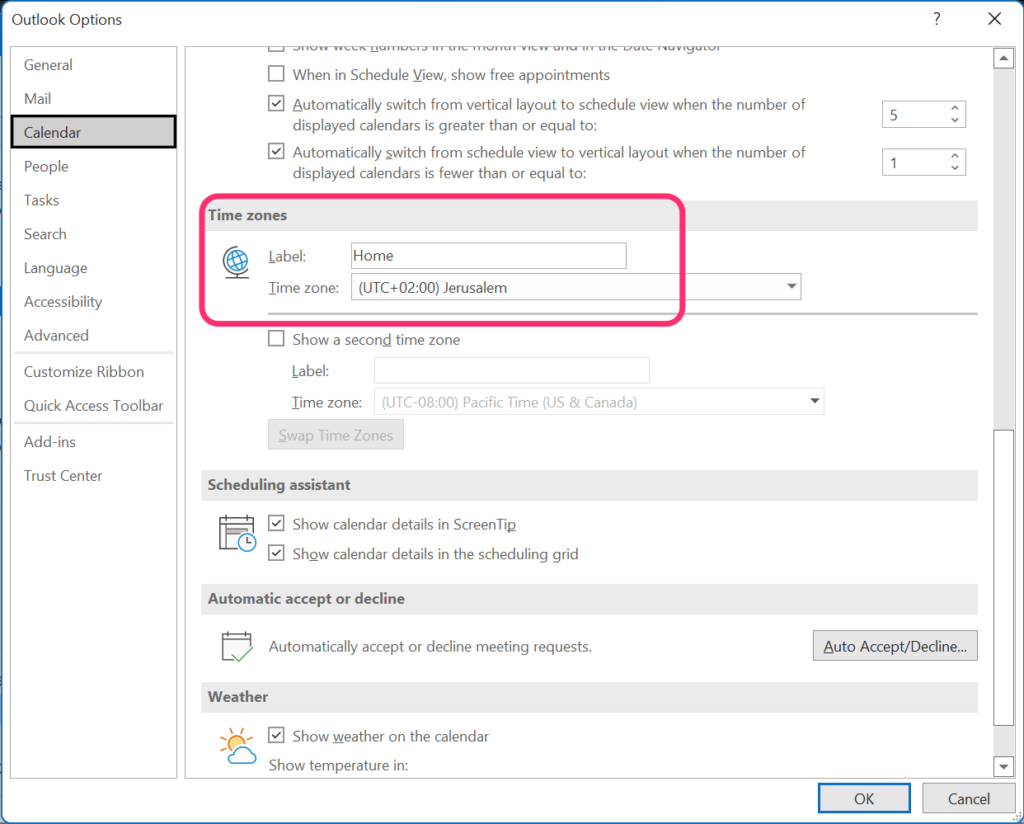
The root cause of the problem seems to be when the computer changes time zones. For example, the Hebcal calendar feed was generated for Tel Aviv, but then the computer or Outlook timezone was changed to London, England.

We have been able to reproduce this issue on Windows 11, and the fix involves 3 steps:

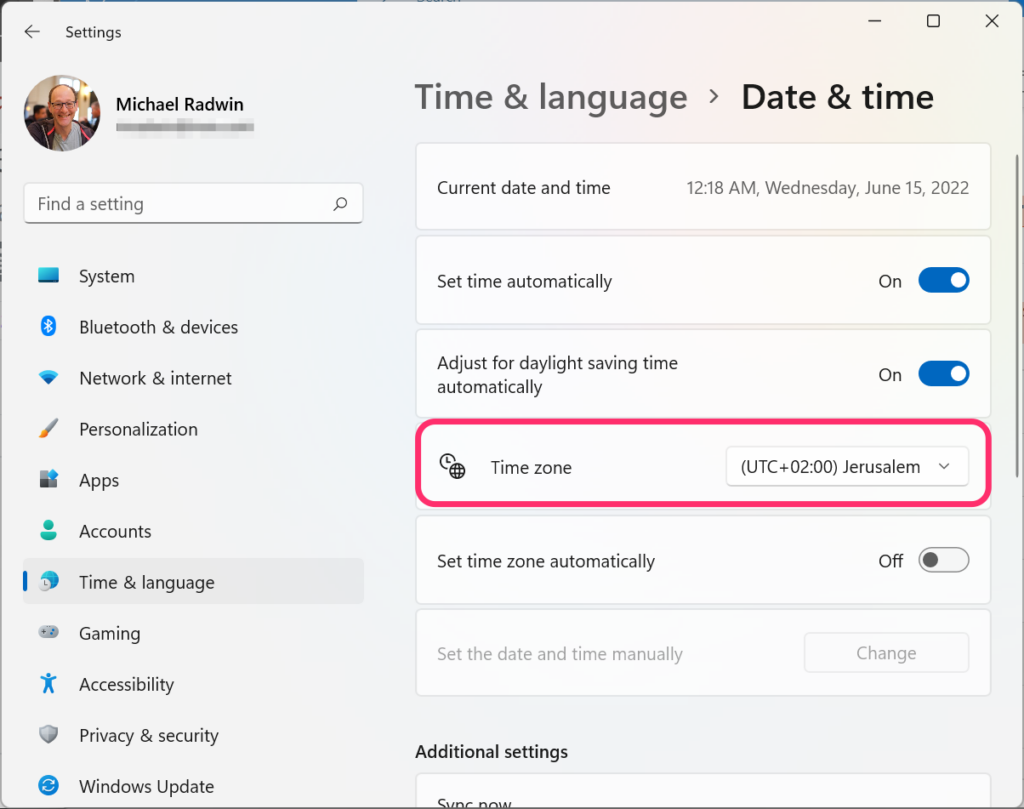
  1. Adjusting the computer’s timezone to match the calendar feed timezone
  2. Adjusting Outlook’s timezone to match the calendar feed timezone
  3. Restarting Microsoft Outlook

If you are experiencing this problem, here are a few examples of what settings to look for and adjust:

Outlook.com Jewish holidays download

The following instructions demonstrate how to subscribe to a Hebcal calendar on Outlook.com (sometimes called “Outlook Web”). Outlook.com calendars are used by Windows 10 & 11, Outlook Mac, and Microsoft email accounts such as Hotmail.com, MSN.com and Live.com.

1. Open a web browser on your computer.

2. Fill out the form with your preferences and click the Create Calendar button

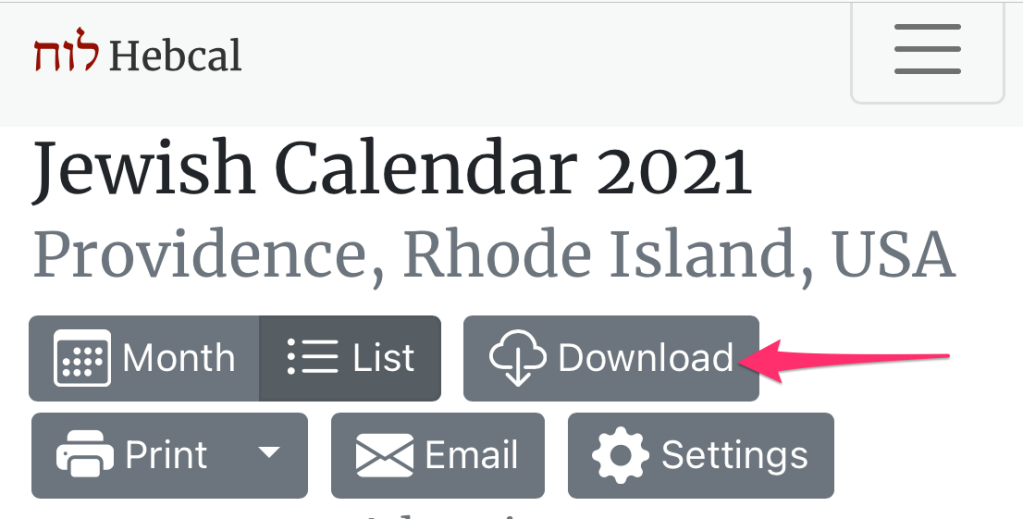
3. Click the Download… button

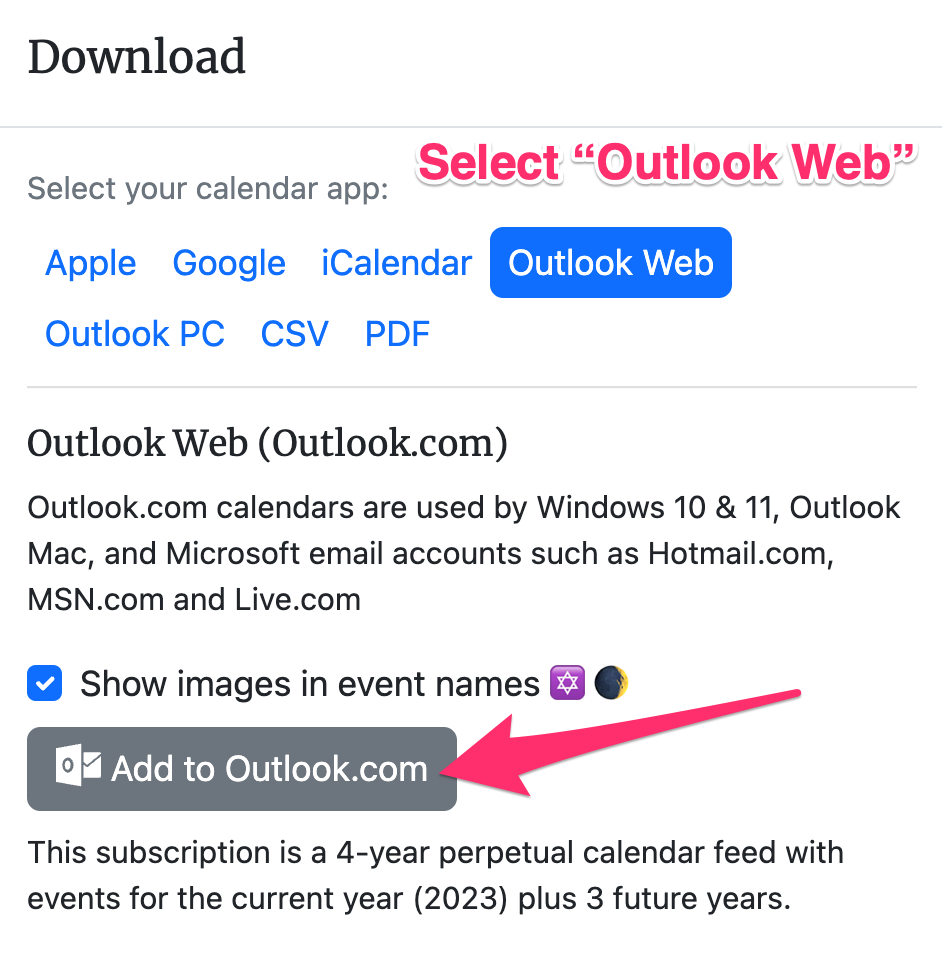
4. Select the Outlook Web option from the Download dialog box. Then click the Add to Outlook.com button.

5. If prompted, login using your Microsoft username and password

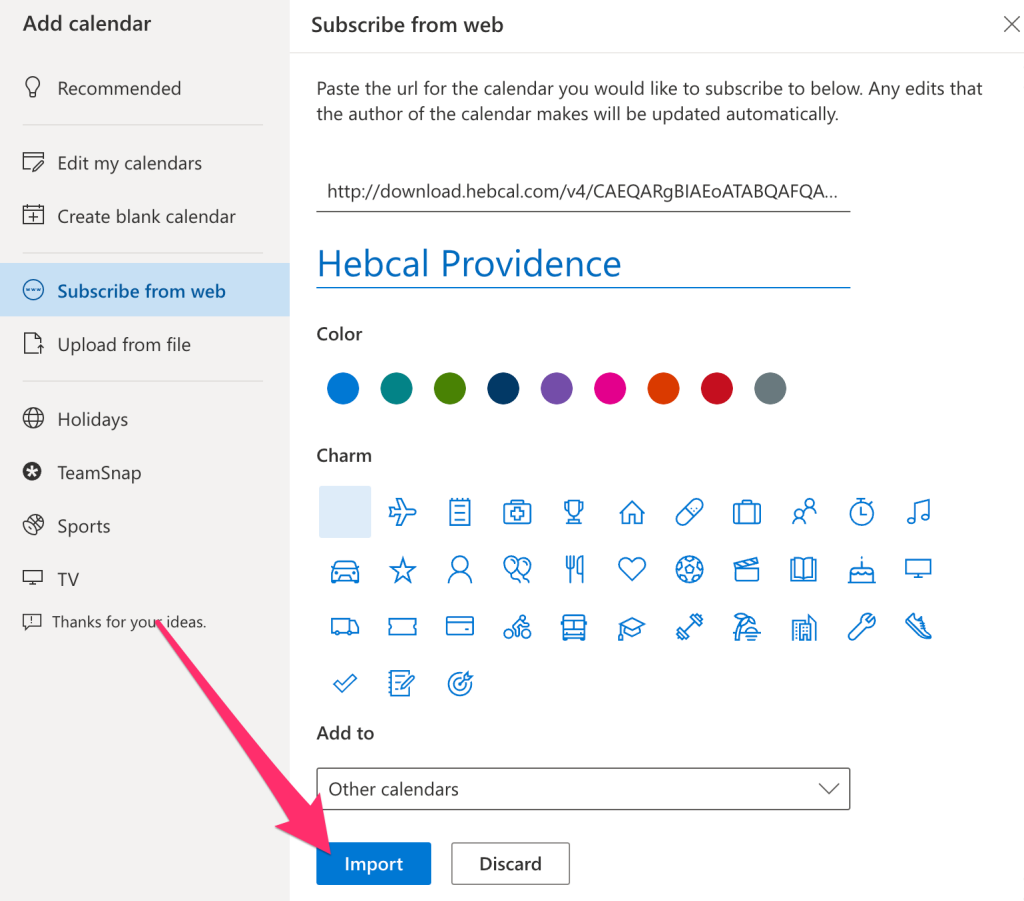
6. When Outlook Web prompts you to Subscribe from web, confirm your options (such as color and charm) and then click the Import button

7. For more details, see Import or subscribe to a calendar in Outlook.com from Microsoft’s support site.

Google Calendar – delete Hebcal

If you subscribed to a Hebcal calendar using our recommended Google Calendar Jewish holidays subscription option, follow our Google Calendar unsubscribe instructions to remove it from your Google Calendar list.

If you manually downloaded Hebcal events using our Google Calendar alternative instructions and imported them into separate calendar (listed under “My calendars”), follow these instructions:

  1. On your computer, open Google Calendar.
  2. In the top right, click Settings  >  Settings.
  3. In the left column, find the calendar you want to delete.
  4. Click the name of the calendar.
  5. Click Remove calendar >  Delete > Delete permanently.

If you manually downloaded Hebcal events and merged them with (embedded them into) your personal calendar, the process is more difficult. Unfortunately, Google does not provide a simple way to bulk delete multiple calendar events. Although there really isn’t another option than to delete each event individually, you can change your view to Schedule view to see more events at once. From here you can delete each event individually and even make use of the search feature to find the events that you’re looking for.

  1. While in Google Calendar, click on the date range dropdown at the top right and change the view to Schedule view.
  2. Click on the magnifying glass icon at the top and search for the events that you’d like to delete. For example, try searching for “hebcal”
  3. Click on an event and then on the trash can symbol in the popup to delete it.

For other recommendations on how to remove multiple events from Google Calendar, see this excellent article: Google Calendar – Delete Multiple Events At Once (2022).