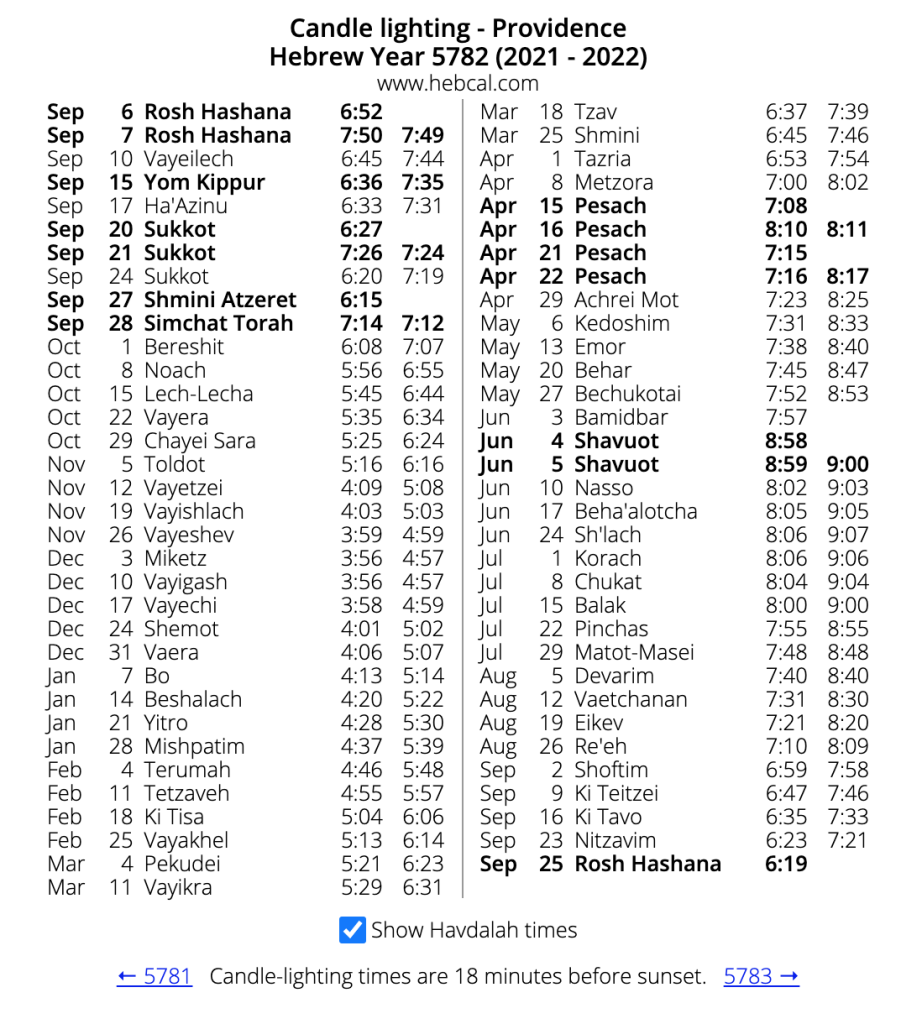
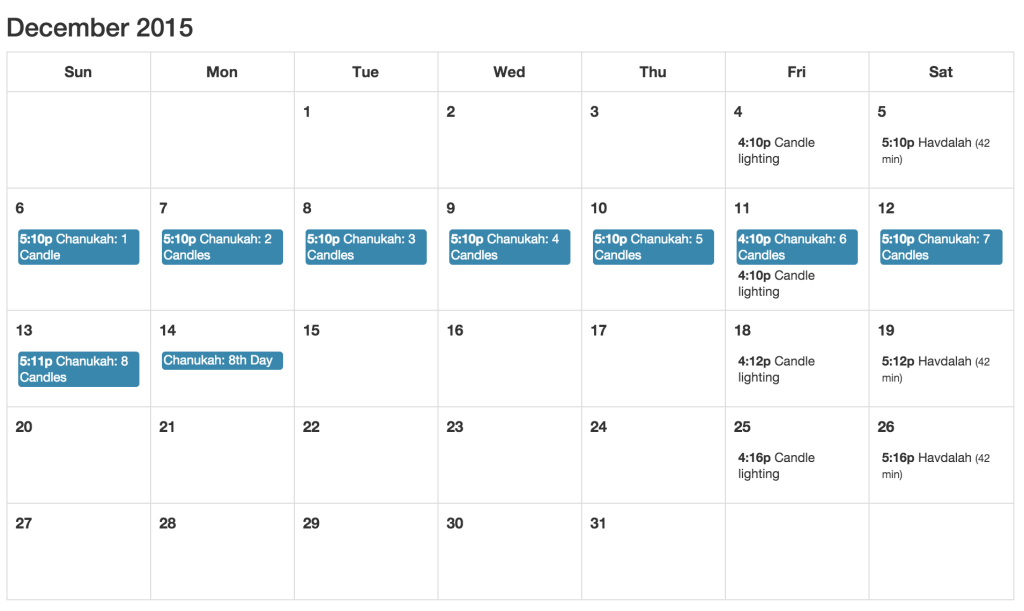
Hebcal can generate Candle-lighting & Havdalah times for Shabbat and holidays, and start and end times for fast days. Over 100,000 world cities are supported.
Candle-lighting times / הַדְלָקַת נֵרוֹת
By default, candle lighting time is 18 minutes before sundown (40 minutes for Jerusalem, 30 minutes for Haifa and Zikhron Ya’akov) on Erev Shabbat (Friday) and Erev Chag (Rosh Hashana, Yom Kippur, Sukkot, Shmini Atzeret, Simchat Torah, Pesach, Shavuot).
Hebcal gives an option to specify a different number of minutes before sunset if you don’t follow the 18-minute minhag (for example, some light candles 20 minutes before sundown).
Chanukah candle-lighting times are at bein hashmashos on weekdays. Rabbeinu Tam holds that bein hashmashos is a specific time between sunset and tzeit hakochavim. One opinion on how to calculate this time is that it is 13.5 minutes before tzies 7.083°. Chanukah candles are lit just before Shabbat candles on Friday, and immediately after Havdalah on Saturday night.
Havdalah / הַבְדָּלָה
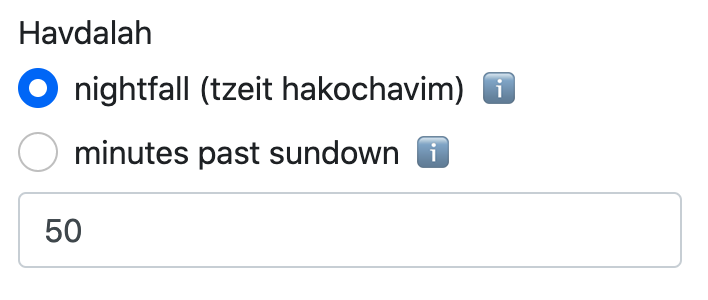
Havdalah is calculated according to tzeit hakochavim / צֵאת הַכּוֹכָבִים, the point when 3 small stars are observable in the night sky with the naked eye (sun 8.5° below the horizon). This option is an excellent default for most places on the planet.
Hebcal also offers the option to use a fixed number of minutes past sundown. Typically one would enter 42 min for three medium-sized stars, 50 min for three small stars, 72 min for Rabbeinu Tam, or 0 to suppress Havdalah times.
Fast times
Minor fasts begin in the morning at alot haShachar / עֲלוֹת הַשַּׁחַר (solar depression 16.1 degrees) and conclude at tzeit for 3 medium sized stars (solar depression 7.083 degrees). Both start and end times are displayed for following minor fasts:
- Tzom Gedaliah
- Asara B’Tevet
- Ta’anit Esther
- Tzom Tammuz
Hebcal displays only a start time for Ta’anit Bechorot because customs vary about when to end the fast (often at a siyyum at the conclusion of morning services).
The fast of Tish’a B’Av begins at sunset and concludes at tzeit for 3 medium sized stars (solar depression 7.083 degrees).
Yom Kippur fast begins before sunset at regular candle-lighting time and concludes at Havdalah time. Hebcal doesn’t display “Fast begins” or “Fast ends” events for YK; instead, the fast start and end times are indicated with the regular “Candle lighting” and “Havdalah” event titles.
Sunset
According to the United States Naval Observatory,
Sunrise or sunset is defined to occur when the geometric zenith distance of center of the Sun is 90.8333 degrees. That is, the center of the Sun is geometrically 50 arcminutes below a horizontal plane. For an observer at sea level with a level, unobstructed horizon, under average atmospheric conditions, the upper limb of the Sun will then appear to be tangent to the horizon. The 50-arcminute geometric depression of the Sun’s center used for the computations is obtained by adding the average apparent radius of the Sun (16 arcminutes) to the average amount of atmospheric refraction at the horizon (34 arcminutes). [USNO]
A note about accuracy
How accurate are candle lighting times?
If you ever have any doubts about Hebcal times, consult your local halachic authority.
If you select a location (or enter geographic coordinates) above the arctic circle or below the antarctic circle, the times are guaranteed to be wrong. The NOAA algorithm used to calculate the position of the sun is inaccurate at extreme northern and southern latitudes.